


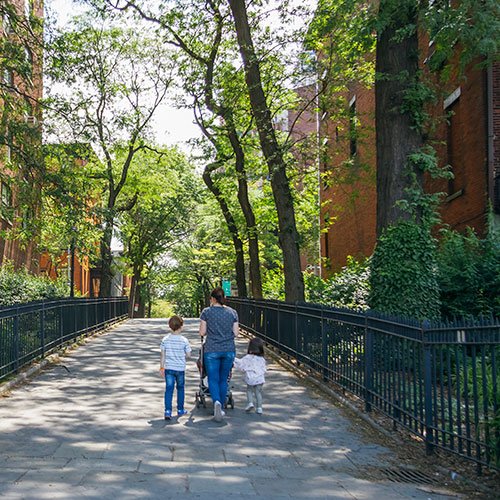
Cary, Illinois is a village of about 18,000 people in southeastern McHenry County, built around a walkable downtown and its own Metra station on the Union Pacific Northwest line. Homes are mostly established resale properties, with a typical price just under $400,000 in 2026, and you get quick access to the Fox River, big parks and conservation areas. It suits buyers who want a smaller-town feel with a direct train to Chicago, plus the Cary-Grove schools and plenty of open space.
I’m Dana Gallagher, a broker with Berkshire Hathaway HomeServices Starck Real Estate, and Cary is one of the Northwest Suburbs towns I serve. Here’s what I want every buyer to know before touring homes in Cary.
Where Cary Is and What the Commute Looks Like
Cary sits in the southeast corner of McHenry County, right on the Fox River. U.S. Route 14 (Northwest Highway) runs through the village alongside the railroad tracks. That makes it easy to hop over to Crystal Lake (about 6 miles) or Algonquin (about 5 miles).
The village started out as “Cary Station,” a railroad stop, and was incorporated in 1893. The train is still the heart of town.
By train: The Cary Metra station is on the Union Pacific Northwest (UP-NW) line to Ogilvie Transportation Center in downtown Chicago. On the current weekday schedule, the fastest morning express trains take about 58 minutes. The all-stop trains take closer to 78 minutes. Off-peak trains run about hourly. Always check Metra’s current schedule.
By car: The Village of Cary puts O’Hare about a 40-minute drive away. Schaumburg is roughly 17 to 18 miles, or about 30 minutes without traffic. Downtown Chicago is a little over 40 road miles, and rush hour can stretch that drive a lot. Most routes follow Route 14 southeast and then pick up I-90.
Cary Neighborhoods and Housing Styles
Cary is mostly an established resale market, not a new-construction town. What you get instead is variety: older homes near downtown, established subdivisions, newer townhomes and wooded riverfront lots. A few names you’ll see a lot:
- Greenfields. Ranch and two-story single-family homes, mostly about 1,300–3,000 square feet, within walking distance of downtown Cary and the Metra.
- Cimarron. Ranch and two-story single-family homes, generally about 1,400–3,000 square feet, west of Cary-Algonquin Road and Route 14.
- Fox Trails. Ranch and two-story single-family homes on lots averaging about a third of an acre, right next to Hoffman Park.
- Cambria. A mix of single-family homes and townhomes near Three Oaks Road and Route 31. The single-family homes have no HOA; the townhomes do.
- West Lake. Two-story townhomes built between 2005 and 2023, just north of Route 14 and Three Oaks Road.
- Trout Valley. Technically its own small village just south of Cary with a Cary mailing address. It’s a wooded, custom-home community along the Fox River, and it’s served by Cary schools.
One important tip: school boundaries split some Cary subdivisions. Parts of Cimarron and most of Cambria, for example, go to Crystal Lake District 47 and Prairie Ridge High School, not District 26 and Cary-Grove. Always confirm the schools for the exact address before you write an offer.
Cary Home Prices and the 2026 Market
Each data source measures things a little differently. Here’s what three showed recently:
- Redfin: Over the three months ending August 2026, Cary’s median sale price was about $390,000 (up 0.2% year over year). Homes sold for about 102% of list price on average, and roughly 58% sold above asking.
- Zillow: The Zillow Home Value Index for Cary was $383,618 as of August 31, 2026, up 5.4% over the past year.
- Realtor.com: In September 2026, Cary’s median listing price was $375,000, the median sold price was $399,000, and there were about 70 active listings with a median of 24 days on market.
What this means for you: Cary is still competitive. Well-priced homes can draw multiple offers, so get fully pre-approved before you tour. Townhomes and older ranches usually come in under the median; larger and riverfront homes run well above it.
Thinking of selling a home before you buy? Start with a free home value estimate so you know your numbers.
Cary Schools
Most of Cary is served by two public districts:
- Cary Community Consolidated School District 26 (Pre-K through 8th grade) has about 2,400 students in five schools: Oak Knoll Early Childhood Center, Briargate Elementary, Deer Path Elementary, Three Oaks Elementary and Cary Junior High School. Three Oaks offers a dual-language program.
- Community High School District 155 runs the high schools. Cary-Grove High School on Three Oaks Road is the main high school for Cary, and some addresses go to Prairie Ridge High School. D155 reports a 93% graduation rate.
Some edges of the village are served by other districts. Homes west of Georgetown Drive and north of Merrimac go to Crystal Lake District 47. Homes in the southern part of Fox Trails (south of Woodbridge Drive) go to Community Unit School District 300 and Dundee-Crown High School. For test scores, look up each school on the Illinois Report Card.
Parks, the Fox River and Things to Do
This is where Cary really shines:
- Hoffman Park. The Cary Park District’s 265-acre park has an off-leash dog area, an accessible fishing pier, community garden plots, trails and the 18-hole Walnut Hollow Disc Golf Course.
- Lions Park. 105 acres with ball fields, a walking trail and a stocked pond. It hosts the Summer Concert Series and Fall-A-Palooza.
- Sunburst Bay Aquatic Center. The Park District’s outdoor water park on First Street.
- Foxford Hills Golf Club. An 18-hole public course owned by the Cary Park District.
- The Hollows Conservation Area. 478 acres run by the McHenry County Conservation District. It’s home to 22-acre Lake Atwood, with a one-mile trail around the lake, fishing, kayaking and trout season every spring.
- Fox Bluff Conservation Area. 279 acres with about 2.5 miles of trail and roughly 3,530 feet of Fox River shoreline.
Downtown Cary is small but charming, with restaurants and shops along Main Street right by the train station. On summer Sundays (May 31 through September in 2026), the Rotary Club of Cary-Grove hosts a farmers market on West Main Street from 9 a.m. to 1 p.m.
Property Taxes in Cary
Let’s be honest: property taxes are the biggest surprise cost for many people moving to Cary. According to the U.S. Census Bureau’s American Community Survey (2020–2024 five-year estimates), the median real estate tax paid by Cary homeowners was $8,089 a year. That compares to $7,274 in McHenry County, $5,298 statewide in Illinois and $3,119 nationally.
A few things to know:
- Taxes are paid a year behind. In McHenry County, the 2025 taxes were billed in 2026 in two installments, due June 9 and September 9, 2026.
- Exemptions matter. The General Homestead Exemption can cut up to $8,000 from the equalized assessed value of an owner-occupied home. Homeowners 65 and older can qualify for an additional Senior Exemption of up to $8,000, and there’s a Senior Assessment Freeze for qualifying household incomes of $75,000 or less.
- The exact bill depends on the address. Before you make an offer, I pull the actual tax history for the home.
Pros and Cons of Living in Cary
Pros
- Its own Metra station and a walkable downtown
- Huge amount of parkland, plus Fox River and Lake Atwood access
- Established neighborhoods with mature trees and a mix of home styles
- District 26 and Cary-Grove High School for most addresses
Cons
- Property taxes are well above the national median
- Limited new construction, so inventory can be tight
- Route 14 gets busy at rush hour
- School boundaries vary within some subdivisions, so you need to check each address
Who Cary Is Best For
In my experience, Cary tends to be a great fit for:
- Chicago commuters who want the train from a smaller town
- Buyers who love the outdoors, whether that’s walking the dog, fishing, golf, kayaking or trails
- Move-up buyers who want an established neighborhood
- Downsizers looking at ranch homes or low-maintenance townhomes like West Lake or Bright Oaks
Cary vs. Crystal Lake and Algonquin
Cary vs. Crystal Lake: Crystal Lake is more than twice Cary’s size (about 40,600 residents vs. about 17,900, per the Census Bureau). It has more shopping, public beaches and more listings. Cary feels quieter and more compact, and Cary-Grove is a sister school to Crystal Lake’s District 155 high schools. Read my full guide to moving to Crystal Lake, IL.
Cary vs. Algonquin: Algonquin (about 30,100 residents) has more Randall Road retail and newer subdivisions, but no Metra station. Cary gives you the train and a traditional small downtown. See my honest take on moving to Algonquin, IL.
Ready to Look at Homes in Cary?
Before real estate, I spent more than 28 years in public service, and I still believe in doing the homework so my clients don’t have to guess. I’d love to help you figure out whether Cary is the right fit for your budget, commute and schools.
- Search current homes for sale
- Find out what your current home is worth
- Contact me or call or text 224-858-0022
Dana Gallagher, Broker (SRES, ABR, SRS) | Berkshire Hathaway HomeServices Starck Real Estate | 13300 Rt 47 Ste 200, Huntley, IL 60142 | mybrokerdana@gmail.com
Frequently Asked Questions About Moving to Cary, IL
Is Cary, IL a good place to live?
For many buyers, yes. Cary offers its own Metra station on the UP-NW line, a walkable downtown, hundreds of acres of parks and conservation land, and District 26 and Cary-Grove High School for most addresses. The trade-offs are high property taxes and limited new construction.
What is the average home price in Cary IL?
It depends on the source. Redfin reported a median sale price of about $390,000 for the three months ending August 2026, and Zillow’s home value index was $383,618 as of August 31, 2026. Realtor.com showed a median sold price of $399,000 in September 2026.
What school district is Cary IL in?
Most of Cary is in Cary Community Consolidated School District 26 for Pre-K through 8th grade and Community High School District 155 for high school, mainly Cary-Grove High School. Some addresses are in Crystal Lake District 47 or Community Unit School District 300, so always verify the schools for a specific home.
How long is the train from Cary to Chicago?
The Metra UP-NW line runs from Cary to Ogilvie Transportation Center in downtown Chicago. On the current weekday schedule, the fastest morning express trains take about 58 minutes, and the all-stop trains take about 78 minutes.
Is Cary IL in McHenry County?
Yes. Cary is a village in southeastern McHenry County, on the Fox River, about 5 to 6 miles from Crystal Lake and Algonquin.
Are property taxes high in Cary, IL?
Yes, compared to most of the country. Census Bureau survey data (2020–2024) put the median real estate tax paid by Cary homeowners at $8,089 a year, versus $3,119 nationally. Homestead and senior exemptions can lower your bill, so make sure they’re applied.
Last updated: September 2026 | Dana Gallagher, Berkshire Hathaway HomeServices Starck Real Estate