

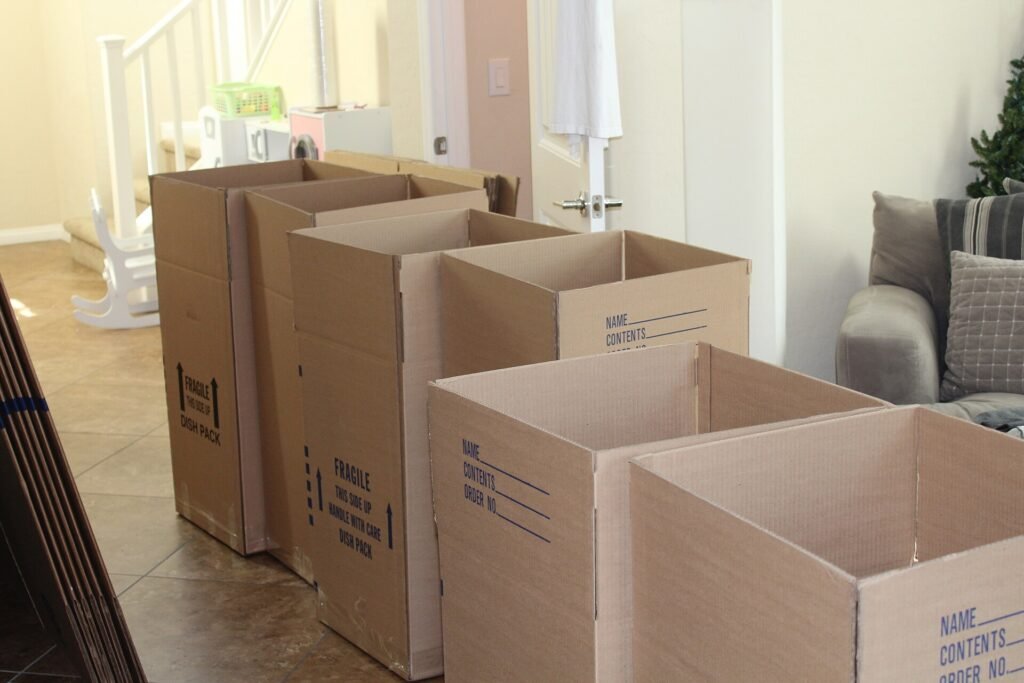
Photo: “Moving-boxes” by MoveON moving, Wikimedia Commons, CC BY-SA 4.0.
Should you sell before or after you buy? Sell first if you need your equity for the down payment or can’t carry two housing payments. Buy first if you can qualify without selling and you’re worried about finding the right next home. Many people land in between, with a contingent offer, a rent-back or a bridge loan.
I’m Dana Gallagher, a Broker with Berkshire Hathaway HomeServices Starck Real Estate. I’m a Seller Representative Specialist (SRS®) and Seniors Real Estate Specialist (SRES®), and this is the number one question I get from move-up buyers and downsizers. Here’s how I help families decide.
Option 1: Sell First, Then Buy
Pros
- You know exactly how much money you have for the next home.
- No risk of paying two mortgages, two tax bills and two sets of utilities.
- Your offer on the next home can be stronger because it isn’t contingent on a sale.
Cons
- You may need a short-term place to live, or have to move twice.
- You’ll feel more time pressure to find the next home.
Best for: buyers who need their equity for the next down payment, and downsizers who want a clean, low-stress move.
Option 2: Buy First, Then Sell
Pros
- You move once, on your schedule.
- You can take your time finding the right home.
- Your current home can be cleared out, staged and shown empty, which often photographs better.
Cons
- You may carry two homes for a while.
- You need to qualify for the new loan while you still own the old home, or have the cash to cover the gap.
Best for: buyers with strong income or savings, and buyers chasing a specific home or neighborhood that doesn’t come up often, like a gated golf community near Barrington.
Option 3: The Middle Ground
These tools can help you do both at once. Talk to your lender and attorney about which fit you.
- Home sale contingency. Your offer depends on your current home selling. It protects you, but sellers often see it as a weaker offer, especially in competitive markets.
- Rent-back (post-closing possession). You sell your home and stay for an agreed period after closing, giving you time to close on the next one.
- Bridge loan or HELOC. Some buyers borrow against their current home’s equity for the next down payment. Ask your lender about the costs and risks.
- Lining up both closings. With good timing, some families close on the sale and the purchase close together, sometimes on the same day.
Questions I Ask Every Client
- Do you need the money from this sale to buy the next home?
- Could you qualify for the new mortgage while still owning this one? A lender can tell you; here’s why you need a pre-approval.
- How fast are homes selling in your town and your price range? Market speed changes everything. If homes like yours sell quickly, selling first is less risky.
- How flexible is your move date? Kids’ school calendars, a new job or a care need can decide it for you.
- What would a second move cost you, in money and stress?
Taxes: One Thing to Ask About
If you sell your main home, the IRS says you may be able to exclude up to $250,000 of gain, or up to $500,000 if you’re married filing jointly. Talk to a tax professional about your situation before you list.
For Downsizers
If you’re moving to something smaller or to a 55+ community, selling first often makes the move simpler and lets you buy with cash or a smaller loan. My 55+ communities guide covers Sun City Huntley, Edgewater and Carillon, and my SRES page explains how I help with the whole transition. If you’re helping a parent sell, see selling an inherited home or a parent’s house in Illinois.
For Move-Up Buyers
If you’re moving up, look at what your budget can buy first, then work backward. My comparisons of what $500K buys and what $750K to $1M+ buys are good starting points. Selling a higher-end home? Read selling a luxury home in the Northwest Suburbs.
Start With What Your Home Is Worth
Every plan starts with a realistic number for your current home. Get my free home value report, or watch my video What Is My Home Worth?. Selling in Huntley? Watch Don’t List Your Huntley Home Until You Watch This and read Selling Your Huntley Home.
Frequently Asked Questions
Is it better to sell your house before buying another?
It’s often better if you need your equity for the next down payment or can’t carry two payments. Buying first can work if you can qualify for both and want to move only once.
What is a home sale contingency?
It’s a condition in your offer that makes the purchase depend on your current home selling. It protects you but can make your offer less competitive.
What is a rent-back?
A rent-back lets you sell your home and stay in it for an agreed time after closing, so you have time to close on your next home.
Can I buy a new house before selling my old one?
Yes, if you can qualify for the new loan while still owning your current home, or use options like a bridge loan or HELOC. Ask a lender.
How much gain can I exclude when I sell my home?
The IRS says you may exclude up to $250,000 of gain on your main home, or up to $500,000 if married filing jointly, if you qualify.
Let’s Map Out Your Move
Every family’s timing is different. Call or text me at 224-858-0022, or contact me here, and we’ll build a plan that fits yours.
Dana Gallagher, Broker (SRES®, CBR, CSR, ABR®, SRS®, Certified Luxury Home agent, BHHS Luxury Collection Specialist) | Berkshire Hathaway HomeServices Starck Real Estate | ★★★★★ 5.0 on Google (40 reviews)
This post is general information, not legal, tax or lending advice. Last updated October 2026.