

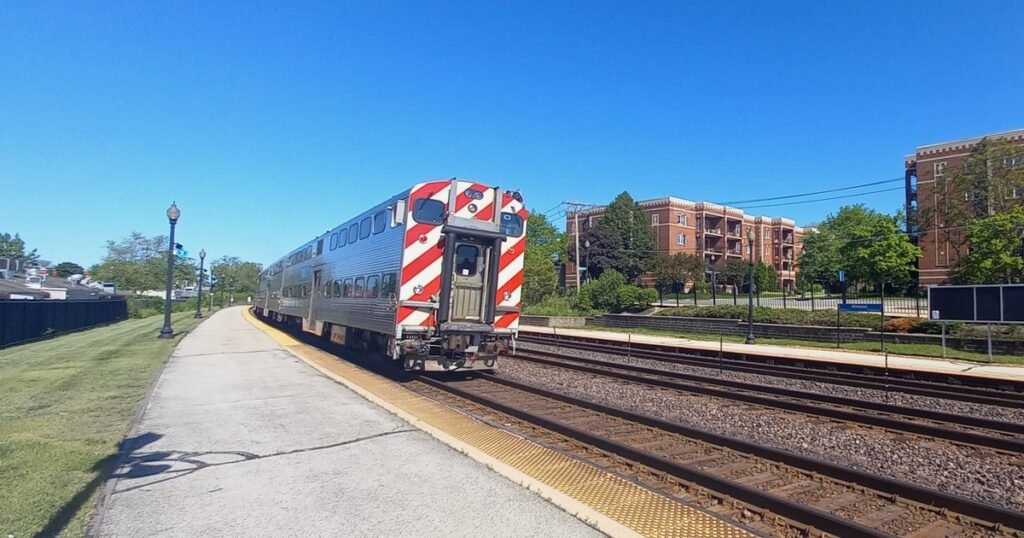
Photo: AlphaBeta135, CC BY 4.0, via Wikimedia Commons

The best Chicago suburb near Metra depends on which downtown station you need, how long a ride you can live with, and your budget. Using Metra’s published weekday schedule, the fastest inbound trains reach downtown in about 27 minutes from Elmhurst, 36 from Arlington Heights, 39 from Naperville, 47 from Barrington and 67 from Crystal Lake. For four of those towns, Zillow’s typical home value as of Sept. 30, 2026 ran from about $382,000 (Crystal Lake) to about $635,000 (Elmhurst).
“It has to be near the train.” I hear that from a lot of buyers, especially people who go downtown a few days a week or want an easy way into the city on weekends. Metra reaches deep into every county I work in. The tricky part is that “near Metra” can mean very different things depending on the line, the station, and the block.
This guide goes line by line through the Northwest, West, and Southwest suburbs. For each line it covers the towns worth a look, real ride times from Metra’s schedule, and recent median prices where I could source them. At the end you’ll find the questions I ask every train-focused buyer before we start touring.
How I measured ride times (and why they’re ranges)
Every ride time in this article comes from Metra’s official GTFS schedule data. That’s the same timetable feed that powers trip planners. I looked at weekday inbound trains that end at the downtown terminal for each line, and for every station I list two numbers:
- Fastest: the quickest scheduled weekday train, usually a rush-hour express.
- Typical: the median of all weekday inbound trains from that station, which is closer to what you’ll get off-peak.
The difference between the two matters. Express trains skip stops and only run at certain hours. If your schedule is flexible or you go in mid-day, plan around the “typical” number. Metra changes schedules from time to time, so check metra.com/schedules for the train you’d actually take before you make a decision.
Know your downtown station first
Metra lines end at different downtown terminals, and the walk from the terminal to your office can add real time:
- Ogilvie Transportation Center: Union Pacific Northwest, West, and North lines.
- Chicago Union Station: BNSF, Milwaukee District West and North, North Central Service, Heritage Corridor, and SouthWest Service.
- LaSalle Street Station: Rock Island.
Ogilvie and Union Station are a couple of blocks apart in the West Loop. LaSalle Street is closer to the financial district. If your office is in Streeterville or the South Loop, factor in a transfer or a longer walk.
Union Pacific Northwest (UP-NW): Ogilvie to the Northwest suburbs and McHenry County
This is the line I know best, and it’s the backbone of the Northwest Suburbs. It runs from Ogilvie through Arlington Heights, Palatine, and Barrington, then up into McHenry County. At Crystal Lake it splits toward Harvard on the main line or McHenry on a branch.
| Station | Fastest weekday inbound | Typical (median) | Fare zone |
|---|---|---|---|
| Arlington Heights | 36 min | 51 min | 3 |
| Palatine | 40 min | 58 min | 4 |
| Barrington | 47 min | 65 min | 4 |
| Cary | 58 min | 76 min | 4 |
| Crystal Lake | 67 min | 85 min | 4 |
| Pingree Road (Crystal Lake) | 64 min | 82 min | 4 |
| Woodstock | 79 min | 97 min | 4 |
| Harvard | 92 min | 110 min | 4 |
| McHenry (branch) | 82 min | limited service | 4 |
Arlington Heights. The downtown station sits right in the middle of restaurants, the Metropolis theater, and newer condo buildings. It has some of the fastest express service on the line. Zillow typical home value: $492,580 (Sept. 30, 2026). More in my Arlington Heights guide.
Palatine. The station is in a compact, walkable downtown, with townhomes and condos close by and single-family neighborhoods spreading out from there. Zillow typical home value: $389,955 (Sept. 30, 2026). See moving to Palatine.
Barrington. A historic downtown with the station right in it, plus a wide range of housing from in-town older homes to larger lots on the edges. See my Barrington guide and Barrington vs. Barrington Hills.
Cary. Smaller, with a station near the village center and access to the Fox River. It’s a good fit if you want the McHenry County feel without going as far out. Zillow typical home value: $380,719 (Sept. 30, 2026). More on moving to Cary.
Crystal Lake. Two stations: the downtown station and Pingree Road, which has its own parking and quick highway access. Zillow typical home value: $381,790 (Sept. 30, 2026). Comparing options? Read Huntley vs. Crystal Lake.
Woodstock, Harvard, and McHenry. These are the end-of-line options, with lower price points and longer rides. Woodstock’s station is a short walk from the historic Square. The McHenry branch has far fewer trains than the main line. Metra’s weekday schedule shows only a handful of inbound runs, so look at the exact times before you count on it. See Woodstock and McHenry.
Milwaukee District West (MD-W): Union Station to Schaumburg, Bartlett, and Elgin
MD-W runs through the northern part of DuPage and Cook counties to Elgin. It’s useful if you want Schaumburg-area convenience with a train option.
| Station | Fastest | Typical | Fare zone |
|---|---|---|---|
| Roselle | 39 min | 55 min | 4 |
| Schaumburg | 44 min | 60 min | 4 |
| Hanover Park | 48 min | 64 min | 4 |
| Bartlett | 51 min | 67 min | 4 |
| Elgin (Chicago St.) | 61 min | 77 min | 4 |
Schaumburg and Roselle. Schaumburg’s station is on the south edge of the village, so most residents drive to it. Roselle has a small, walkable downtown at its station. If you’re also weighing nearby towns, see Hoffman Estates vs. Schaumburg.
Bartlett. The station is right in the village’s downtown. Housing ranges from established neighborhoods near the tracks to newer subdivisions farther out. See moving to Bartlett.
Elgin. The biggest city on the line, with several stations and a riverfront downtown. Zillow typical home value: $340,323 (Sept. 30, 2026). More in my Elgin guide.
Union Pacific West (UP-W): Ogilvie to Elmhurst, Wheaton, Geneva, and Elburn
UP-W is the busiest line through central DuPage County and on into Kane County. It has some of the shortest ride times in this guide.
| Station | Fastest | Typical | Fare zone |
|---|---|---|---|
| Elmhurst | 27 min | 40 min | 3 |
| Glen Ellyn | 37 min | 53 min | 4 |
| College Ave. (Wheaton) | 40 min | 56 min | 4 |
| Wheaton | 43 min | 59 min | 4 |
| Geneva | 60 min | 76 min | 4 |
| Elburn | 72 min | 88 min | 4 |
Elmhurst. It has the fastest ride in this guide and a busy downtown built around the station. Zillow typical home value: $635,289 (Sept. 30, 2026).
Glen Ellyn and Wheaton. Both have historic downtowns right at the station. Wheaton has two stops, downtown and College Avenue. Wheaton’s Zillow typical home value: $507,044 (Sept. 30, 2026). For the county overview, see living in DuPage County.
Geneva. A Fox River downtown with shops and restaurants close to the station. Zillow typical home value: $551,416 (Sept. 30, 2026).
Elburn. The end of the line, with newer construction near the station and a small-town setting. See moving to Elburn.
BNSF: Union Station to Westmont, Naperville, and Aurora
The BNSF is Metra’s busiest line, with frequent service and a lot of express trains. That’s why the fastest and typical times are so far apart.
| Station | Fastest | Typical | Fare zone |
|---|---|---|---|
| Westmont | 36 min | 47 min | 3 |
| Lisle | 37 min | 58 min | 4 |
| Naperville | 39 min | 64 min | 4 |
| Route 59 (Naperville/Aurora) | 45 min | 68 min | 4 |
| Aurora | 54 min | 75 min | 4 |
Naperville. The downtown station is a short walk from the Riverwalk area, and the Route 59 station on the city’s south side has a lot of parking. Zillow typical home value: $618,458 (Sept. 30, 2026). Station parking in Naperville is a common question. Look at the city’s permit and daily parking options before you assume you can park and ride.
Aurora and Kendall County. Aurora is the end of the line, and it’s the closest station for many people living in Kendall County towns like Oswego, Montgomery, and Yorkville. See living in Kendall County.
Will County lines: Rock Island, Heritage Corridor, and SouthWest Service
Will County is served by three Metra lines, which is more than people expect.
| Station (line) | Fastest | Typical | Fare zone |
|---|---|---|---|
| Tinley Park–80th Ave. (Rock Island) | 34 min | 48 min | 4 |
| Tinley Park (Rock Island) | 42 min | 45 min | 3 |
| Mokena–Hickory Creek (Rock Island) | 44 min | 56 min | 4 |
| New Lenox (Rock Island) | 50 min | 62 min | 4 |
| Joliet (Rock Island) | 60 min | 71 min | 4 |
| Orland Park–143rd St. (SouthWest Service) | 45 min | 50 min | 4 |
| Orland Park–179th St. (SouthWest Service) | 55 min | 60 min | 4 |
| Lemont (Heritage Corridor) | 46 min | limited service | 3 |
| Romeoville (Heritage Corridor) | 54 min | limited service | 4 |
| Lockport (Heritage Corridor) | 60 min | limited service | 4 |
Rock Island trains go to LaSalle Street Station. SouthWest Service and Heritage Corridor trains go to Union Station.
Mokena and New Lenox. Both are Rock Island towns with frequent service and stations close to their village centers. Mokena’s Zillow typical home value: $458,404 (Sept. 30, 2026).
Joliet. Joliet is served by both the Rock Island and the Heritage Corridor, at a lower price point. Zillow typical home value: $267,651 (Sept. 30, 2026).
Heritage Corridor towns (Lemont, Romeoville, Lockport). This line runs mostly at rush hour, inbound in the morning and outbound in the evening, with very few trains. It works for a regular weekday office commute, but not for flexible or weekend trips. Plainfield doesn’t have its own station, so people there usually drive to Route 59, Romeoville, or Joliet. See moving to Plainfield and living in Will County.
DeKalb County: Drive to Elburn
DeKalb County has no Metra station. Buyers in Cortland, Sycamore, and DeKalb who want the train usually drive east to Elburn, the end of the UP-W line. Elburn’s fastest weekday inbound train reaches Ogilvie in 72 minutes. See living in DeKalb County and moving to Cortland.
North Central Service: Wheeling and Buffalo Grove
North Central Service (NCS) runs to Union Station with fewer trains than the main lines, mostly weekday service. Wheeling’s fastest weekday inbound train takes 49 minutes (typical 55, Zone 3), and Buffalo Grove’s takes 53 minutes (typical 61, Zone 4). If NCS times don’t fit your schedule, many people in these towns drive to an Arlington Heights or Palatine UP-NW station instead. See moving to Wheeling.
Fares and fare zones, briefly
Metra prices fares by zone. Downtown terminals are Zone 1. In this guide, Elmhurst, Westmont, Arlington Heights, Wheeling, Tinley Park, and Lemont are Zone 3, and nearly every other station is Zone 4. Metra’s current fare table lists a one-way fare of $5.50 for Zones 1–3 and $6.75 for Zones 1–4. There are also monthly passes and day passes. Fares change, so check the Metra fare table for current prices before you budget.
What “near Metra” should mean to you
- Walk, bike, or drive? A home a few blocks from the station is a different lifestyle, and usually a different price, than one ten minutes away by car. Both can work.
- Parking. Many stations have permit waitlists or limited daily spaces. Check the municipality’s rules before you count on parking.
- Train noise and horns. Homes right by the tracks hear trains and, at some crossings, horns. Visit at rush hour before you make an offer.
- Express stops. Being close to an express stop can save a lot of time over a station a mile away. Compare the “fastest” columns.
- Weekend service. If weekend trips into the city matter, check Saturday and Sunday schedules. Some lines barely run on weekends.
- Total commute. Add the walk or drive to the station and the walk from the downtown terminal to your office.
Frequently asked questions
Which Chicago suburb has the shortest Metra ride? Of the stations in this guide, Elmhurst on the UP-W had the fastest scheduled weekday inbound train, at 27 minutes to Ogilvie.
Which Metra line has the most trains? The BNSF line has the most frequent service, with many express trains during weekday rush hours.
Are homes near Metra stations more expensive? Often they are, especially in walkable downtowns. Prices vary a lot by town, though, as the medians above show. I’m happy to pull recent comparable sales near any station you’re considering.
Can I live in McHenry County and take the train downtown? Yes. The UP-NW serves Cary, Crystal Lake, Woodstock, Harvard, and McHenry, with fastest scheduled rides from 58 minutes (Cary) to 92 minutes (Harvard).
Let’s find your station
If the train matters to your next move, tell me where you work and how often you go in. I’ll help narrow down the stations and neighborhoods that fit your budget and commute. Already own a home? Start with a free home value estimate, or contact me or call 224-858-0022.
Ride times are from Metra’s published GTFS weekday schedule as of October 2026. Home values are Zillow Home Value Index figures as of Sept. 30, 2026. Schedules, fares, and prices change, so confirm current information before you make a decision.
Dana Gallagher, Broker, Berkshire Hathaway HomeServices Starck Real Estate